Our Aims

Our Club's aims are to:

Learn collaboratively about the history, heritage and archaeology of Norwich and Norfolk

Develop resources and activities that contribute to the wider community’s understanding of history and archaeology

Develop activities that enhance/maintain the wellbeing and emotional resilience of club members

Be actively inclusive – open, accessible and welcoming to all


Sunday, 20 July 2025

Ragged Staff Graffiti

Here is a picture of the alleged “Ragged Staff” at St Peter Hungate of mid 15th century origin.  The "Ragged Staff" in the context of graffiti refers to a heraldic symbol, specifically a knotted stick or staff with branches protruding from it, often associated with the Earls of Warwick in medieval times. It's found as graffiti, particularly in churches, and is sometimes mistaken for a simple outline or a heraldic symbol of the Earls of Warwick.  However, given that the “Ragged Staff” is quite frequently seen, research suggests it also had religious significance, possibly linked to St. Christopher, pilgrimage, and even concepts of resurrection.  Here is a link for supplemental reading if you are interested:

https://ritualprotectionmarks.com/2023/06/05/the-virgin-mary-the-ragged-staff-a-stick-to-beat-the-devil-with/#:~:text=The%20ragged%20staff%20symbol%20is,Torode%202022%2C%20Champion%202017).


Sunday, 13 July 2025

Humphry Repton

Thanks to Chris Tracy and his team at the Heritage Centre for the excellent session they put on for us on Tuesday.  To answer the question I asked during Tuesday’s session, Humphrey Repton compiled 400 red books.  This article details his life for those that wish for further reading on him:

https://thegardenstrust.org/news/humphry-repton-life-work/

Saturday, 12 July 2025

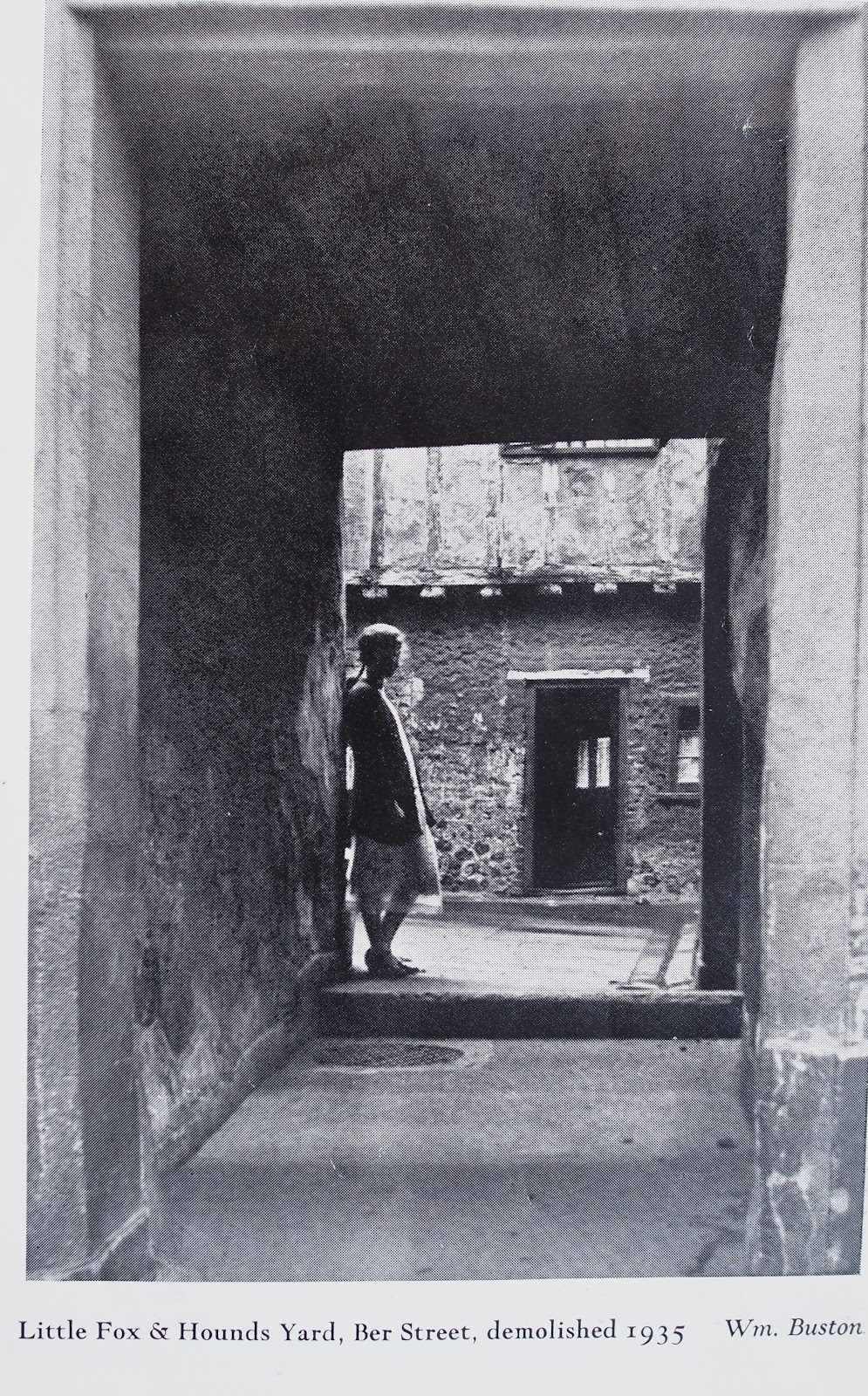
William Buston, Norwich Photographer

 These photos by William Buston ARPS are taken from The Norfolk Annual, October 1936 (first two) and Oct 1938.  They were part of an article in the latter entitled “Colegate. An Ancient Norwich Way”.  Not much is known about William Buston – a photographer in Norwich in the late 1930’s. George Plunkett, a much-better known Norwich photographer of the 20th c. mentions one of Buston's photos in reference to "Ber Street" - "In the Norfolk Annual published in October 1937, there appeared a photograph by William Buston of this building, (Bond’s) taken from the entrance to Golden Ball St, and captioned "Corner Doomed to Destruction" - an accurate prophecy, although not for the reason the photographer had envisaged."
 I have found out that an album of early twentieth century photographs including many by Buston is part of the Bridewell Museum's holdings.  I understand that the photos are also now digitised into the Picture Norfolk collection at the Heritage Centre in the Forum.
I have been unsuccessful in finding out if there are other editions of The Norfolk Annual, but if anyone spots any, I would be happy to purchase them. There are quite a few more photos  in the two mags (by other photographers) and I will try to post some on the Club page over the next weeks.


Sunday, 29 June 2025

Norwich Stuff

We had a great session in the Heritage Centre called "Silks, shawls and other stuff" on Tuesday.  Lot's of artefacts from the archive and well researched information from Chris Lacy and the team.  A big thank you to them.  Anyway, I hadn’t heard of the term “Norwich Stuff” until Chris mentioned it at this session, so here is an article that explains all:  

https://www.humphriesweaving.co.uk/norwich-wool-stuff/

Sunday, 22 June 2025

Wymondham

After a great day out in Wymondham on 10th June, for those that wish to supplement their learning on Wymondham after our visit, I attach the following link which makes reference to; the market cross, fire of 1615, the abbey and plenty more:  

https://www.heritage.norfolk.gov.uk/record-details?TNF1561-Parish-Summary-Wymondham-(Parish-Summary)#:~:text=It%20is%20known%20that%20Wymondham,with%20some%20very%20intricate%20detailing.

Sunday, 25 May 2025

Lyveden New Bield

I visited Lyveden Manor House and the New Bield (New Build) this week.  These were two houses about a mile apart, one a manor house and the other a half built “Secret House”.  Too close to the main house for use as a hunting lodge, keeping a secret house was a custom of the 16th century.  Often within a mile of the main house, the secret house was a place where the head of the household would retire for a few days with a minimum of servants, while the principal house was thoroughly cleaned and, bearing in mind the sanitation of the time, fumigated.  Secret Houses were probably never intended for full-time occupation.  Here are pictures of the manor house (first photo) and the New Field (second photo):


Monday, 5 May 2025

Norwich Public Library

I was talking to Merton on Saturday at a family gathering and he showed me some pictures of the Norwich Public Library that was located on St Andrews Street.  He has memories of collecting and returning library books to this library, maybe you have some memories too.  It was the first non-subscription library – built in 1857. The 1850 Libraries Act allowed larger boroughs to add up to half a penny in the pound to the rates to pay for library facilities and staff. Norwich Council was first to adopt the Act and Norwich was first to construct its own Free Library which opened in 1857 at the corner of St Andrew’s (Broad) Street and Duke Street.  Towards the end of its life, the Free/Public Library was used as a shoe factory and in 1963 it was demolished to give way to the new Central Library in Bethel Street.  

Here are some pictures.  The last picture shows the Norwich Telephone Exchange that has been built on the site of the old Norwich Public Library which of course in medieval times was the site of the Duke of Norfolk’s Palace: